




MOMAX 1-World² 45W 5-Port Dual AC Travel Adapter UA31 [Hong Kong Official Product]
Inventory: In stock (estimated to ship within one business day)
Delivery and shipping fees (Free shipping on orders over HK$500)
International Shipping
Free-shipping thresholds · Power Bank surcharge
Hong KongFREE
SF Locker: Free for all orders · Door-to-door: Free over HK$500
Macau
Free shipping on orders HK$800+ (2-3 business days)
Australia (6-12 business days depending on area or zone)
Free over AU$100 · Flat AU$9.99 below
United Kingdom 0-3kg (3 - 5 business days); 3kg+ (5 - 8 business days)
Free over £40 · Flat £6.99 below
Singapore (5 - 8 business days)
Free over S$40 · Flat S$9.99 below
European Union (6 - 10 business days)
Free over €49 · Flat €9.99 below
Malaysia (6 - 10 business days)
Free over RM40 · Flat RM9.99 below
🇦🇺Australia — Power Bank
| Weight | Fee |
|---|---|
| 0 – 0.51 kg | AU$ 24.39 |
| 0.51 – 1.01 kg | AU$ 36.99 |
| 1.01 – 1.51 kg | AU$ 55.99 |
🇬🇧United Kingdom — Power Bank
| Weight | Fee |
|---|---|
| 0 – 0.51 kg | £ 9.99 |
| 0.51 – 1.1 kg | £ 15.99 |
| 1.1 – 1.51 kg | £ 22.99 |
🇸🇬🇲🇾SG / Malaysia — Power Bank
| Weight | Fee |
|---|---|
| 0 – 0.51 kg | SGD 18.99 |
| 0.51 – 1.01 kg | SGD 23.99 |
| 1.01 – 1.51 kg | SGD 27.99 |
🇮🇪Ireland — Power Bank
| Weight | Fee |
|---|---|
| 0 – 0.51 kg | € 26 |
| 0.51 – 1 kg | € 39 |
| 1 – 1.51 kg | € 51.99 |
🇨🇦Canada — Power Bank
| Weight | Fee |
|---|---|
| 0 – 0.51 kg | CA$ 37.05 |
| 0.51 – 1.01 kg | CA$ 58.33 |
| 1.01 – 1.51 kg | CA$ 82.41 |
⚡ Express Shipping — free option available, refer to checkout.
📦 Heavy / Oversized items (e.g. water dispenser) — contact customer service for a custom freight quote.
Warranty
Maintenance Terms and Conditions / Warranty Information
DIGIBAL Official Warranty Coverage
This product is Authentic Hong Kong goods, enjoy Original factory one-year warranty (Unless otherwise specified on the product page). Customers must keep this information safe. Purchase receipts and products Hong Kong distributor of skin care stickers (It is recommended to take photos for record-keeping). If the product malfunctions during the warranty period, the customer must...Contact the Hong Kong general agent directly. Arrange for testing and repair.
🌏 Overseas (US / CA / UK / SG / AU)
All products are Hong Kong official versions supplied with a UK-style 3-pin plug. Travel adapters are not included. Warranty coverage ranges from 1 to 2 years, with all servicing performed in Hong Kong. Local return warehouses available in Australia, UK and USA.
Contact CSProvide photos/videos
Submit photos/videos
Local ReturnShipping costs are paid by the customer first.
Customer pays upfront
Ship to HK Maintenance arranged by the company
Warranty processed
Reimbursement Full refund upon presentation of receipt
Full refund of postage
Overseas customers may choose between the following two options:
For other countries, please contact customer service for a return address.
MOMAX 1-World² 45W 5-Port Dual AC Travel Adapter UA31 [Hong Kong Official Stock] | MOMAX Hong Kong Official Stock
100-240V 50/60Hz 10A 2500W (max)
Product Introduction
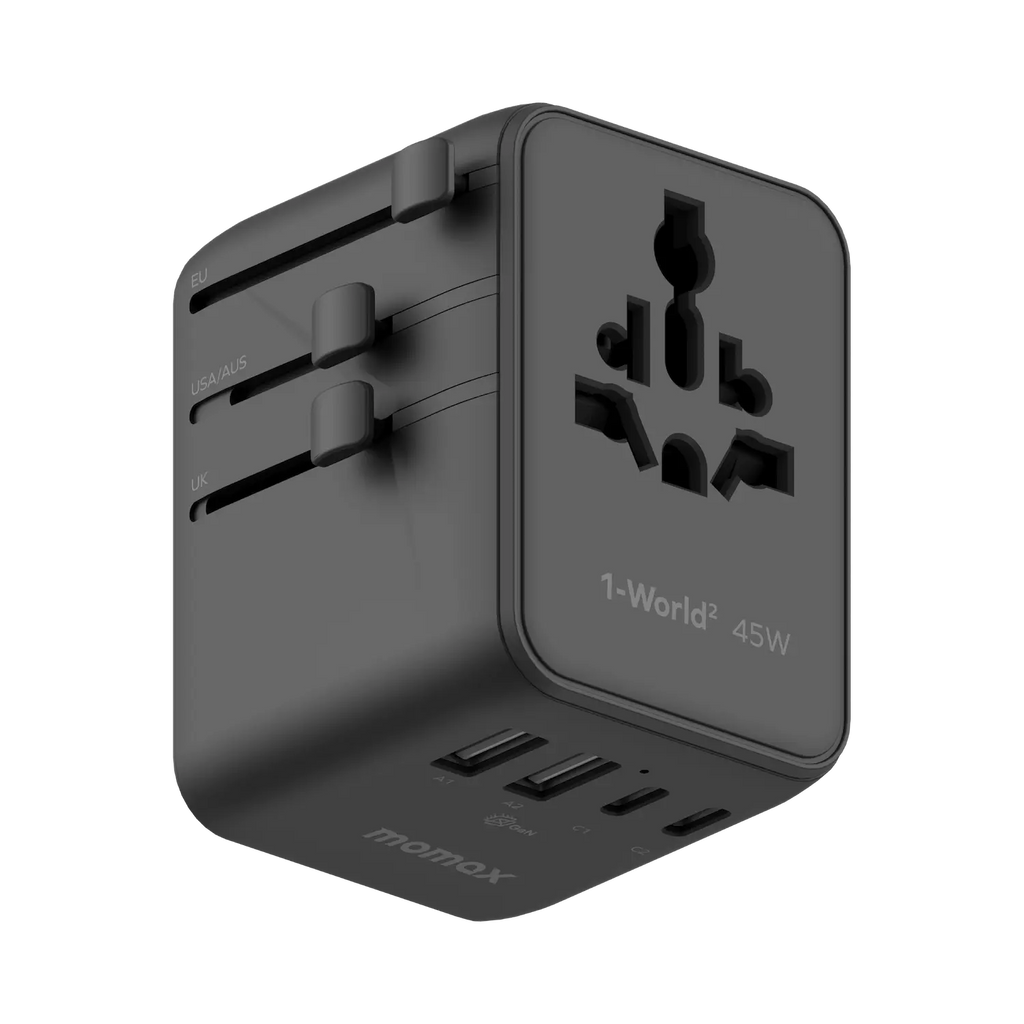
MOMAX 1-World² 45W 5-Port Dual AC Travel Adapter UA31 [Hong Kong Official Stock] is a travel adapter product. The official specifications list: Rated input voltage range 100-240V 50/60Hz 10A 2500W (max); Pin specifications CN/TW/US; UK/EU/AU.
Compatible devices: Never compromise on connectivity again. With 5 strategically designed output ports - 3x USB-C PD and 2x USB-A - you can simultaneously charge your laptop, smartphone, tablet, and accessories.、Dual AC Output Innovation、What sets the 1-World2 apart is its groundbreaking dual AC output capability. Power two AC devices simultaneously with both universal plug and Type-A plug options, giving you unprecedented flexibility whether you're charging cameras, portable speakers, or other essential travel electronics.、Global Compatibility、Designed for the modern nomad, the 1-World2 works seamlessly across 180+ countries. From the bustling streets of Tokyo to the cafes of Paris, you'll have reliable power access wherever your adventures take you.。
When choosing a travel adapter, first confirm the socket type at your destination, the total power consumption of the devices you will bring, and whether you need USB-A to accommodate older devices; once these three factors are determined, the required wattage and number of ports will naturally narrow down.
Six Key Highlights
Rated input voltage range
The input specifications determine the recharging speed; chargers that support PD recharge noticeably faster.
Impact on actual use: 100-240V 50/60Hz 10A 2500W (max)
- Pin specifications:CN/TW/US; UK/EU/AU
- USB-C3 output:5V 3A / 9V 3A / 12V 3A / 15V 3A / 20V 2.25A 45W (max)
USB-C3 output
The output specifications determine which devices can be fast-charged; the protocols must match for fast charging to activate.
Impact on actual use: 5V 3A / 9V 3A / 12V 3A / 15V 3A / 20V 2.25A 45W (max)
- Rated input voltage range:100-240V 50/60Hz 10A 2500W (max)
- Pin specifications:CN/TW/US; UK/EU/AU
USB-C1/C2 output
The output specifications determine which devices can be fast-charged; the protocols must match for fast charging to activate.
Impact on actual use: 5V 3A
- Rated input voltage range:100-240V 50/60Hz 10A 2500W (max)
- Pin specifications:CN/TW/US; UK/EU/AU
USB-A1/A2 output
Output specifications determine which devices can fast charge; the protocols must match for fast charging to activate.
Practical impact: 5V 2.4A
- Rated input voltage range:100-240V 50/60Hz 10A 2500W (max)
- Pin specifications:CN/TW/US; UK/EU/AU
USB-C3 + C1/C2 output
Output specifications determine which devices can fast charge; the protocols must match for fast charging to activate.
Practical impact: PD 27W + 5V 3A
- Rated input voltage range:100-240V 50/60Hz 10A 2500W (max)
- Pin specifications:CN/TW/US; UK/EU/AU
USB-C3 + A1/A2 output
Output specifications determine which devices can fast charge; the protocols must match for fast charging to activate.
Practical impact: PD 27W + 5V 2.4A
- Rated input voltage range:100-240V 50/60Hz 10A 2500W (max)
- Pin specifications:CN/TW/US; UK/EU/AU
What's in the box
The contents listed below are for Hong Kong official stock packaging. Actual accessories may vary by shipment batch. If you have any questions, please confirm with us before placing your order.
- Package contents may vary by shipment batch. If you need to confirm any specific accessories, please contact us before placing your order.
- Hong Kong official stock; warranty coverage is subject to this product page and the distributor's terms.
Suitable scenarios
MOMAX 1-World² 45W 5-Port Dual AC Travel Adapter UA31 [Hong Kong official stock] is suitable for the following situations:
- Never compromise on connectivity again. With 5 strategically designed output ports - 3x USB-C PD and 2x USB-A - you can simultaneously charge your laptop, smartphone, tablet, and accessories.
- Dual AC Output Innovation
- What sets the 1-World2 apart is its groundbreaking dual AC output capability. Power two AC devices simultaneously with both universal plug and Type-A plug options, giving you unprecedented flexibility whether you're charging cameras, portable speakers, or other essential travel electronics.
- Global Compatibility
Why choose this model
- Rated input voltage range:100-240V 50/60Hz 10A 2500W (max)
- Pin specifications:CN/TW/US; UK/EU/AU
- USB-C3 output:5V 3A / 9V 3A / 12V 3A / 15V 3A / 20V 2.25A
- USB-C1/C2 output:5V 3A
- USB-A1/A2 output:5V 2.4A
- USB-C3 + C1/C2 output:PD 27W + 5V 3A
Full specifications
Compare within the same series
The table below shows the actual specifications of this model, so you can compare them with the requirements of your devices when making a purchase.
| Item | MOMAX 1-World² 45W 5 |
| Rated input voltage range | 100-240V 50/60Hz 10A 2500W (max) |
| Pin specifications | CN/TW/US; UK/EU/AU |
| USB-C3 output | 5V 3A / 9V 3A / 12V 3A / 15V 3A / 20V |
| USB-C1/C2 output | 5V 3A |
| USB-A1/A2 output | 5V 2.4A |
| USB-C3 + C1/C2 output | PD 27W + 5V 3A |
| USB-C3 + A1/A2 output | PD 27W + 5V 2.4A |
| USB-C1/C2 + A1/A2 output | 5V 3A |
Frequently Asked Questions
Q: Before buying, how do I know whether it will fit the sockets at home?
A: Check the socket location: if there are twin sockets side by side, a switch directly above, a raised surround around the socket, or the socket is near the edge of a wall, the thick plug body may hit the surround and may not sit flush. It may also cover the switch. It is best to measure the available space before buying.
Q: The plug won't fit into the socket. Is the product defective?
A: No. There is nothing wrong with the plug; the issue is the socket placement. Any thick plug will get blocked in these positions. Use a power strip with local safety certification to separate the plugs, and it will work.
Q: What should I注意 when using a power strip?
A: Choose a power strip with overload protection and local safety certification (for example, choose SAA/RCM certification in Australia/New Zealand). Plug the product directly into the power strip, do not connect one power strip to another, and leave enough space for heat dissipation.
Q: What can I use instead if I don't want to add a power strip?
A: Consider a compact GaN charger. It is much smaller and can fit in narrow socket spaces. Keep travel adapters for use when travelling; hotel sockets are generally more spacious and less likely to be obstructed.
Q: Before buying, how do I know it fits my sockets at home?
A: Look at the socket spot: twin sockets side by side, a switch directly above, a raised surround, or a position near a wall edge - a full-size plug body will hit the surround and may not sit flush, and can cover the switch. Measure the space before buying if unsure.
Q: The plug will not go in - is the product faulty?
A: No. The plug itself is fine; it is the socket placement - any full-size plug jams in those spots. A certified power board with space for each plug solves it.
Q: Anything to watch out for with power boards?
A: Choose one with overload protection and local safety certification (e.g. SAA/RCM in Australia/New Zealand); plug the adapter directly into the board, never daisy-chain boards, and leave room for heat dissipation.
Q: I would rather not use a power board - any alternatives?
A: Consider a slim GaN charger - much smaller and fits tight spots; keep the travel adapter for trips, where hotel sockets usually have more room.
Q: Which slider should I use for Japan / the US / Australia / the UK?
A: Slide according to the labels: USA = Japan / the US (flat pins); AUS = Australia / New Zealand / mainland China (angled pins); UK = the UK / Hong Kong / Singapore (three rectangular pins); EU = Europe / Korea (round pins). Slide out only one type at a time; slide out the pins before plugging in, and retract them before unplugging.
Q: Is this also a voltage converter?
A: No. A travel adapter only changes the shape of the pins; it does not change the voltage - a 110V-only appliance (such as some US hair dryers) will burn out when used in a 220V region. Most modern phone / computer / camera chargers support 100–240V universally (check the fine print on the device); confirm before use.
Q: Can the AC outlets and USB ports be used at the same time?
A: Yes, each port supplies power independently, but the combined load must not exceed the total power limit marked on the unit. When using the USB-C high-wattage port to power a laptop, we recommend plugging other high-power devices into separate outlets. See the specifications table for the exact combination limits for each model.
Q: Why are there two fuse slots on the back of the unit?
A: One holds the fuse in use, while the other is a SPARE FUSE. If the fuse blows due to an overload, use a small screwdriver to open the compartment and replace it with the spare. If it blows again after replacement, the load is too high - do not use a higher-wattage fuse.
Q: Can I use it every day at home in Hong Kong?
A: It depends on the model: models with a UK plug setting on the back can be temporarily used with Hong Kong sockets. However, travel adapters are designed for travel, and some models carry a label on the back stating “Not designed for connection to Hong Kong power outlets” - for long-term home use, please use a standard plug adapter or power strip.
Q: Can I take it on a plane?
A: Yes. A travel adapter itself contains no battery, so it is allowed in both carry-on and checked luggage. Note that it is different from a “power bank / portable charger” - those contain batteries and may only be carried in hand luggage, not checked luggage.
Q: Which slider for Japan / the US / Australia / the UK?
A: Slide per the label: USA = Japan/US (flat pins); AUS = Australia/NZ/mainland China (angled pins); UK = UK/Hong Kong/Singapore (three rectangular pins); EU = Europe/Korea (round pins). Slide one at a time; slide out before unplugging.
Q: Is this also a voltage converter?
A: No. A travel adapter only changes the pin shape, not the voltage - a 110V-only appliance (like some US hair dryers) will burn out on 220V. Modern phone/laptop/camera chargers are mostly 100-240V universal (check the fine print on the charger) - confirm before use.
Q: Can the AC socket and USB ports be used at the same time?
A: Yes - each output is independent, but the total must stay under the rated maximum printed on the body. When charging a laptop on the high-wattage USB-C port, keep other heavy loads off. See the model spec table for combinations.
Q: Why are there two fuse slots on the back?
A: One is the active fuse, the other is the SPARE FUSE - if it blows from overload, swap in the spare with a small screwdriver. If the new one blows too, the load is over the limit - do not fit a higher rating.
Q: Can I use it daily at home in Hong Kong?
A: Depends on the model: with a UK pin mode it fits Hong Kong sockets for occasional use; but travel adapters are designed for trips, and some models carry a sticker saying they are not designed for Hong Kong mains sockets - for everyday home use, use a regular charger.
Q: Can I take it on a plane?
A: Yes. A travel adapter has no battery, so it is fine in both cabin and checked luggage. Note the difference from power banks - those contain batteries and must go in cabin baggage only.
MOMAX 1-World² 45W 5-Port Dual AC Travel Adapter UA31 [Hong Kong Official Stock]: Choose Based on Your Devices
Tell us which devices you will charge and how many you will use at the same time, and we will help confirm whether this model is sufficient.
MOMAX|Local Support


